Welcome To TERMINUS GROUP
terminus@tslsmart.com

What Is Spatial Intelligence? How Digital Twins and AIoT Create Smarter Spaces
Table of Content
[Hide]
As cities, campuses, and commercial environments become increasingly connected, simply collecting data from devices is no longer enough. Organizations need technology that can understand physical environments, interpret changing conditions, and support better decisions in real time. This evolution has led to the emergence of spatial intelligence, a new approach that combines artificial intelligence, IoT, digital twins, and spatial computing to create smarter and more adaptive spaces.
Unlike traditional IoT systems that mainly focus on connecting devices, spatial intelligence enables spaces to become understandable, computable, and continuously optimized. By integrating physical environments with digital models and AI capabilities, organizations can transform buildings, campuses, and urban areas into intelligent ecosystems.
What Is Spatial Intelligence?
Spatial intelligence is the ability of an intelligent system to understand physical spaces, analyze relationships between people, objects, devices, and environments, and use this understanding to support automated decisions and actions.
In traditional smart environments, different systems often operate independently. Lighting management, security monitoring, energy control, parking systems, and building management platforms may collect large amounts of data, but the information is usually separated across different platforms.
Spatial intelligence changes this approach by creating a unified understanding of space. It connects physical elements such as rooms, equipment, vehicles, people, and environmental conditions into a digital model that can be analyzed and optimized.
The evolution can be summarized as:
| Technology | Main Capability | Limitation |
| IoT | Connects physical devices and collects data | Mainly focuses on monitoring |
| AIoT | Adds AI capabilities to connected devices | Intelligence often remains scenario-specific |
| Digital Twin | Creates a digital representation of physical environments | A model alone cannot optimize operations |
| Spatial Intelligence | Understands relationships within spaces and enables intelligent decisions | Requires integration of multiple technologies |
This means spatial intelligence is not simply another monitoring system. It represents a shift from connected spaces to understood and optimized spaces.
How Digital Twin Technology Enables Spatial Intelligence
Digital twin technology provides the digital foundation that allows spatial intelligence systems to represent, analyze, and interact with physical environments.
A digital twin creates a dynamic digital representation of a real-world object, building, or environment. Unlike a static 3D model, an intelligent digital twin continuously connects with real-time data from sensors, devices, and operational systems.
For example, a smart campus digital twin can represent:
Building structures and spatial layouts
Equipment and facility conditions
Energy consumption patterns
Occupancy information
Environmental conditions
Operational events
When combined with AIoT capabilities, a digital twin becomes more than a visualization tool. It becomes an operational interface that helps organizations understand what is happening, predict what may happen, and determine what actions should be taken.
A smart building digital twin can support applications such as:
Predictive equipment maintenance
Energy optimization
Intelligent space management
Emergency response coordination
Visitor navigation and management
The relationship between digital twins and spatial intelligence can be understood as:
Digital Twin = Digital representation of space
Spatial Intelligence = Understanding and optimizing that space
Together, they allow physical environments to become measurable, analyzable, and continuously improved.
The Role of AIoT in Building Intelligent Spaces
AIoT (Artificial Intelligence of Things) combines IoT connectivity with artificial intelligence algorithms. It enables devices not only to collect information but also to analyze conditions and respond intelligently.
In a spatial intelligence system, AIoT works as the connection layer between physical environments and intelligent decision-making.
A typical workflow includes:
Physical Environment - Connected Devices - Data Collection - Spatial Model - AI Analysis - Intelligent Action
For example:
Sensors detect occupancy changes in a meeting room.
The spatial model identifies the room status.
AI analyzes usage patterns.
The system automatically adjusts lighting, temperature, or reservation settings.
This combination of AIoT and digital twins creates an AIoT digital twin environment where physical spaces can continuously communicate with their digital counterparts.
Terminus Group develops intelligent infrastructure based on technologies including AIoT platform, edge computing, smart devices, and spatial intelligence capabilities. These technologies enable different systems within buildings, campuses, and cities to work together instead of operating as isolated applications.
How Spatial Intelligence Platforms Transform Smart Spaces
A spatial intelligence platform typically combines multiple technology layers to create a complete intelligent operating system for physical environments.
The core architecture usually includes:
| Layer | Function |
| Physical Layer | Collects information through sensors, devices, and connected equipment |
| Data Integration Layer | Combines information from different systems and sources |
| Spatial Model Layer | Creates digital representations of buildings, campuses, and environments |
| AI Intelligence Layer | Analyzes data and generates optimization strategies |
| Application Layer | Supports scenarios such as buildings, campuses, parking, and communities |
| Operation Layer | Enables monitoring, automation, and continuous improvement |
This architecture allows organizations to move beyond individual automation scenarios.
For example, a traditional parking system may only recognize vehicles and available spaces. A spatial intelligence approach can connect parking information with traffic conditions, visitor management, building operations, and energy systems to create a more coordinated experience.
Case Study: How Terminus Group Applies Spatial Intelligence in iFlytek Town
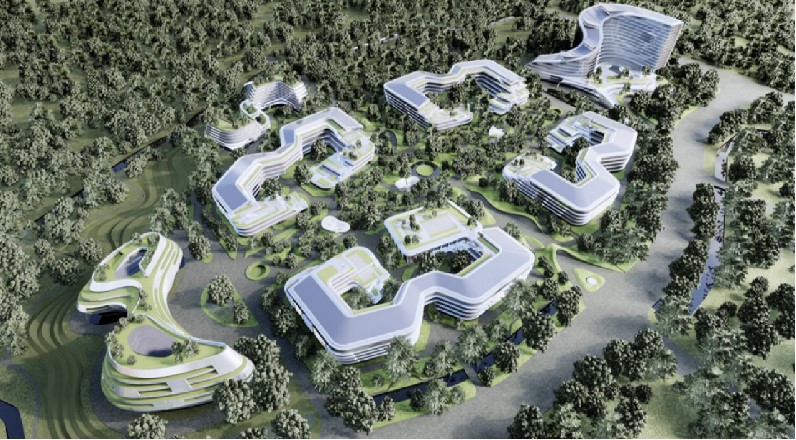
One example of spatial intelligence application is Terminus Group’s implementation in iFlytek Town.
The project demonstrates how a large-scale campus can move beyond traditional device connectivity toward a more integrated intelligent space model.
Through Terminus Group’s spatial intelligence technologies and Meta-Space capabilities, different physical elements within the campus can be digitally represented and connected. Instead of treating buildings, rooms, devices, and operational systems as separate assets, the environment can be understood as a unified digital space.
The implementation focuses on several key capabilities:
Unified Spatial Understanding
Traditional smart campus systems often contain multiple independent platforms. Spatial intelligence helps integrate different types of information into a common spatial model, allowing operators to better understand relationships between people, equipment, and environments.
Digital Twin-Based Operations
The digital twin provides a real-time representation of the physical campus. It supports applications such as spatial visualization, navigation, facility management, and operational analysis.
Intelligent Scenario Optimization
By combining AI, IoT data, and spatial models, intelligent systems can support scenarios including:
Smart building management
Energy optimization
Intelligent meeting spaces
Campus operations
Facility monitoring
The value of this approach is not only connecting more devices. The key improvement is making the entire environment understandable and capable of continuous optimization.
From Smart Buildings to Intelligent Spaces
The development of smart environments is moving from simple automation toward intelligent coordination.
A traditional building management system may answer:
“Is the device working?”
An AIoT-enabled smart environment can answer:
“What is happening in this space?”
A spatial intelligence system can go further:
“What should this space do next?”
This transformation creates new possibilities for intelligent space solutions across industries.
In commercial buildings, spatial intelligence can improve energy efficiency and occupant experiences. In campuses, it can support safer and more efficient operations. In cities, it can connect multiple services through a shared digital foundation.
For organizations exploring this transformation, Terminus Group provides solutions combining AIoT, digital twins, and intelligent applications. Its smart building solution applies AIoT technologies to improve building operations, while smart campus solution capabilities help create more connected and efficient educational and industrial environments.
Conclusion
Spatial intelligence represents the next stage of intelligent infrastructure development. While IoT connects devices and digital twins represent physical environments, spatial intelligence adds the ability to understand relationships, analyze situations, and optimize operations.
By combining digital twin technology, AIoT, and intelligent platforms, organizations can transform traditional buildings, campuses, and urban spaces into adaptive environments that continuously improve.
The future of smart spaces will not only depend on how many devices are connected, but on how effectively spaces can understand data, make decisions, and work together.
Frequently Asked Questions
What is spatial intelligence technology?
Spatial intelligence technology enables systems to understand and analyze physical environments by combining AI, IoT, digital twins, and spatial data. It helps organizations manage and optimize buildings, campuses, and cities more intelligently.
How is spatial intelligence different from IoT?
IoT mainly focuses on connecting devices and collecting data. Spatial intelligence goes further by understanding relationships between physical elements and using AI to support decisions and optimization.
What role does a digital twin play in spatial intelligence?
A digital twin creates a dynamic digital representation of a physical environment. It provides the foundation for monitoring, analysis, simulation, and intelligent decision-making.
How can spatial intelligence improve smart buildings?
Spatial intelligence can help smart buildings optimize energy use, improve facility management, enhance occupant experiences, and enable more efficient operations through real-time data and AI analysis.
References / External Resources
Digital Twin – Wikipedia
Internet of Things – IBM
Artificial Intelligence of Things (AIoT) – IEEE Xplore
References