Welcome To TERMINUS GROUP
terminus@tslsmart.com

TERMINUS Spatial Intelligence Deployed in Shanghai Jing’an: Smart Communities Powered by Large Spatial Models
Table of Content
[Hide]
Recently, AIoT company TERMINUS entered into a partnership with CSCEC Jiuhe to jointly support the smart development of the Lingshi Community in Jing’an District, Shanghai. The collaboration will deliver an end-to-end spatial intelligence solution powered by TERMINUS's Spatial Large Model and coordinated spatial intelligent agents, enabling the community to explore the upper bounds of modern intelligent service management and operations, and to establish a benchmark smart community that is safer, more convenient, more energy-efficient, and more intelligent.
CSCEC Jiuhe is a well-known brand under China State Construction Engineering Corporation (CSCEC). Previously, TERMINUS collaborated with CSCEC Jiuhe on the full-stack solution for the CSCEC Vanke "Ideal Land" project. The Lingshi Community involved in this new partnership is located in the Daning area of Jing'an District, Shanghai, covering a total area of approximately 47 mu, and comprising eight high-rise residential buildings and one office building. It is one of Jing'an District's key projects for 2025.
Aligned with the project's goals of improving the living environment, enhancing management capabilities, and building a zero-carbon community, TERMINUS adopts spatial intelligence as the unified system core to deliver an end-to-end solution spanning five key scenarios: comprehensive security, energy efficiency and carbon reduction, intelligent operations and maintenance, a unified "identity passport," and digital concierge services.

Based on this solution, the management efficiency of the Lingshi Community has been comprehensively improved. In terms of security control, the solution provides an intelligent security management system. Leveraging computer vision technology, trajectory analysis, and intelligent alarms, the solution can achieve comprehensive real-time security management and intelligent linkage for the community. Additionally, thanks to intelligent functions, the community can achieve automatic task dispatch, progress tracking, and closed-loop management, improving problem-solving efficiency and service quality. The unified "identity passport" provides users with multiple smart-driven access methods, realizing the linkage of access control, elevator control, consumption, and other scenarios, thus enhancing the transit experience for residents and visitors.
Simultaneously, based on this solution, the community's operating costs have been comprehensively optimized. The solution uses an intelligent energy management system to achieve detailed analysis and control of energy consumption, optimize energy usage efficiency, and reduce energy operating costs. Furthermore, the AI-driven predictive maintenance mechanism can effectively extend the life cycle of equipment, reduce the risk of sudden failures, and optimize operation and maintenance costs. Through data analysis and modeling, the solution realizes the reasonable allocation and optimized utilization of community resources, further improving operational efficiency.
The solution enhances the service experience of the community by building diversified services. Smart parking service provides users with functions like parking space reservation and unattended payment, solving the problem of parking; Comfortable space service uses domain model-driven environmental monitoring and intelligent regulation to achieve precise adaptation to the space environment, improving residents' comfort; Additionally, based on intelligent interactive functions, the solution can provide users with multiple personalized services, enriching their experience.
Moreover, based on data-driven intelligent decision-making and an end-to-end intelligent operation platform, the Lingshi Community can achieve further sustainable development. Through big data analysis and modeling, the solution provides scientific evidence for community planning, construction, and operation; Intelligent energy management, carbon asset management, and the intelligent operation platform assist the community in achieving energy-saving and emission reduction goals while realizing comprehensive digital transformation of community operations.
This June, TERMINUS officially released its spatial intelligence strategy, specifying the technical pathway of using spatial large models as the core computing and inference engine to collaborate with spatial intelligent bodies for autonomous decision-making, execution, and interaction. The Lingshi Community solution also follows this approach.
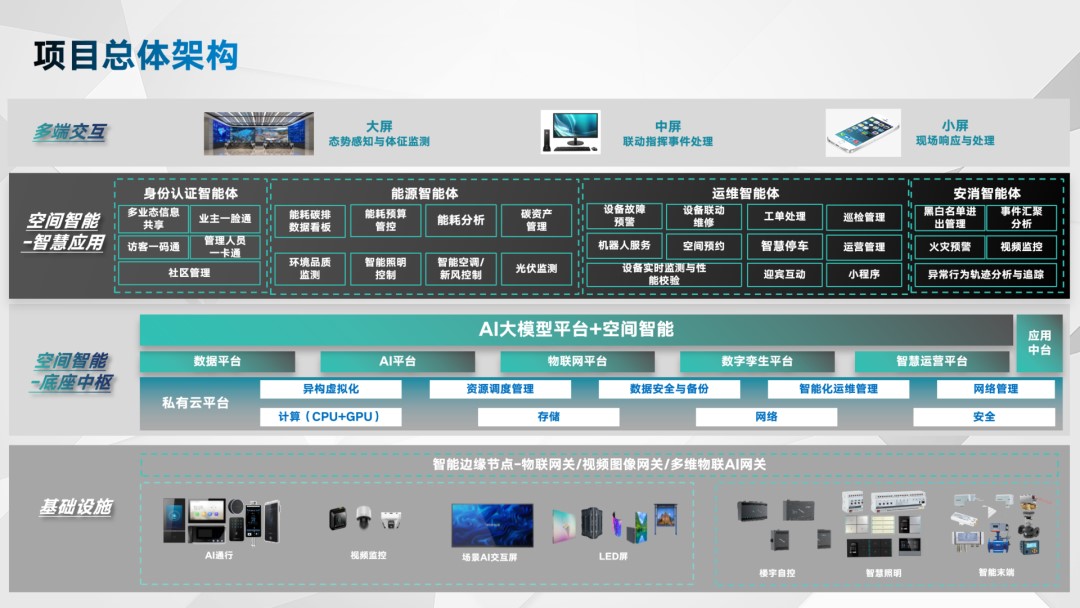
It is particularly worth mentioning that the solution architecture is designed with "replicable and easily expandable" as core design principles, achieving high scalability of the platform through standardized packaging of underlying technologies and modular development of top-level applications.
TERMINUS looks forward to enhancing the overall value of physical spaces through end-to-end spatial intelligence, creating a new paradigm for safer, more convenient, more energy-efficient, and smarter community life.
References