Welcome To TERMINUS GROUP
terminus@tslsmart.com

Terminus Group's Space Intelligence Solutions Implemented in iFlytek Town: Structuring Spatial Elements with Meta-Space
Table of Content
[Hide]
Meta-Space: Terminus Group Creates a New Engine for Spatial Intelligence Implementation
In the accelerated implementation of spatial intelligence, efficiently understanding and aligning multi-source heterogeneous data within a space has always been a common challenge in the industry. To address this issue, Terminus Group has proposed building a Meta-Space element governance platform to break through the bottleneck of unstructured governance of spatial elements through three levels of structuring capabilities. Currently, the Meta-Space platform and its full-stack solution have been successfully implemented in the iFlytek AI Town project, becoming a demonstration case for large-scale application of spatial intelligence.
The Key Issue of Unstructured Data Governance
Unstructured data refers to data that lacks a fixed structure or predefined model. It comes in various forms and usually exists in a natural state, requiring technologies like NLP, CV, OCR, etc., to extract valuable information. In the physical world, such data is widespread: from geospatial data (satellite images, GIS coordinates), environmental and scientific data (remote sensing images, geological exploration), to everyday textual data (emails, documents, comments), multimedia data (images, videos, audio), and various types of perception data generated by IoT.
According to IDC research, by 2025, the total amount of global data will increase from 16ZB in 2016 to 163ZB, with about 80% being unstructured or semi-structured data. Quickly transforming this massive amount of data into structured forms is a core issue in advancing spatial intelligence and the vision of "everything can be computed." The creation of Meta-Space is aimed at addressing this challenge.
Meta-Space: Structuring Capabilities for Digital Space
As the smallest governance unit of physical space, Meta-Space aims to connect complex business scenarios within a space, achieving IoT device coordination, real-time strategy production, and twin scenario construction, thereby promoting bidirectional interaction between the physical world and the digital twin world.
In Terminus Group's spatial intelligence engine, Meta-Space is a crucial tool linking the perception layer and the inference layer, completing the tokenization of spatial elements. It has three structuring capabilities:
IoT data structuring: Aggregating discrete device data (such as lighting, air conditioning, access control) into the Meta-Space unit for unified parsing, achieving spatialized device management.
Rule data structuring: Converting expert experience (like energy-saving rules, security procedures) into 127 types of iteratable AI strategy libraries, supporting data-driven scientific decision-making and strategy execution.
Environmental data structuring: Converting entities like buildings and devices into computable twin model coordinates, achieving standardized expression of spatial relationships.
With this system, Meta-Space acts as the "ETL engine" of the spatial intelligence era:
Extract — Extracting fragmented spatial data through a unified modeling language;
Transform — Defining data associations and business logic based on spatial units;
Load — Outputting executable spatial scheduling instructions, creating an evolving strategy knowledge base.
Ultimately, this drives the transformation of physical space from unstructured "chaos" to computable intelligent space.
Space as a Service: The Practice Sample of iFlytek AI Town
Leveraging Meta-Space, the space itself becomes a service entity that can be scheduled and optimized, creating a new model of "Space as a Service."
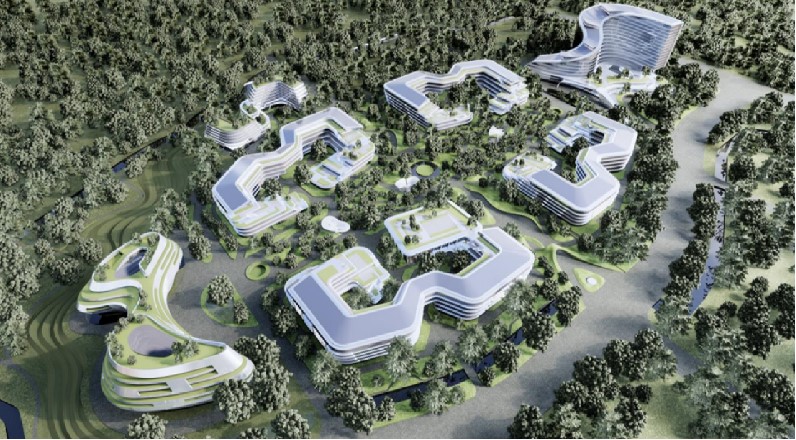
This concept has been fully implemented in the iFlytek AI Town. The first phase of the project spans 223 acres, planning to accommodate over 15,000 employees and setting up more than 5000 parking spaces. It aims to create a tech demonstration park integrating research, office, and industrial clusters.
Facing common pain points in large parks such as fragmented security control, rough energy management, inefficient space utilization, and slow maintenance responses, Terminus Group has built an intelligent solution based on the Meta-Space platform covering 25 types of spatial scenarios, including office, dining, reception, meetings, health, and business.
Through this solution:
More efficient security control: 3D twin models achieve mutual recognition and communication of data, with spatial strategy libraries generating cross-unit linkage logic, breaking down independent system barriers.
More refined energy management: The physical space is broken down into the smallest controllable units, elevating energy efficiency management from rough whole-building statistics to precise square meter-level control.
More efficient space utilization: Discrete elements (such as meeting rooms, devices, booking information) are structured into business flows, replacing manual scheduling and enhancing overall space utilization.
More precise maintenance response: Through space-device twin binding, digital mirrors are created for elevators, water pipes, meters, etc., allowing quick fault locating and precise maintenance.
As of January 2025, the iFlytek AI Town has achieved a 5.7% reduction in overall electricity consumption, with significant improvements in security control and space maintenance efficiency.
Towards a Scalable Future of Spatial Intelligence
Human understanding of spatial relationships often relies on intuition, while machines need to gradually learn through structured data and model training. Globally, exploration of spatial data governance and spatial intelligence models is still in the early stages.
The proposal of Meta-Space is an important experiment in unstructured data governance by Terminus Group and a key practice in its "model + system" implementation path. In the future, Terminus Group will continue to explore the integration training and inference strategies of unstructured data, accelerating the combination of direct and indirect intelligent computing, and promoting the large-scale application of spatial intelligence in more scenarios.
References